The following instructions explain how to configure a node within the Shares application. These instructions assume that you have already installed the Shares application and Enterprise Server v3.0+ on your local machine (along with the appropriate licenses). Before you continue, make sure that you have the following information available:
- The node computer's hostname or IP address, along with a port and path (if applicable).
- The node API username and password, which you created when you set up Enterprise Server on your node machine.
-
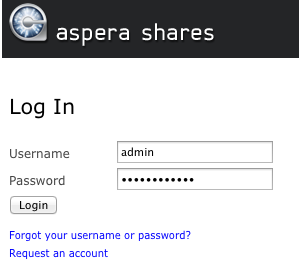
Log into the Shares application with your admin username and password.
On the computer that has the Shares application installed on it, launch your web browser and go to https://localhost/. Log in with your admin username and password.
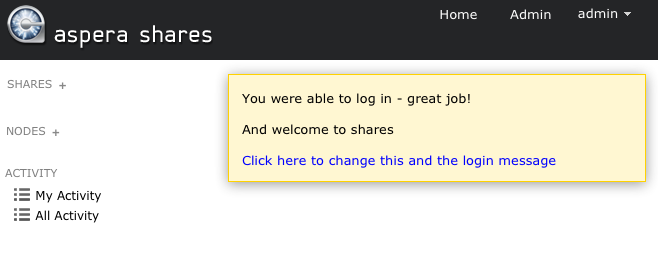
Once logged in, you will arrive at your Home screen.
-
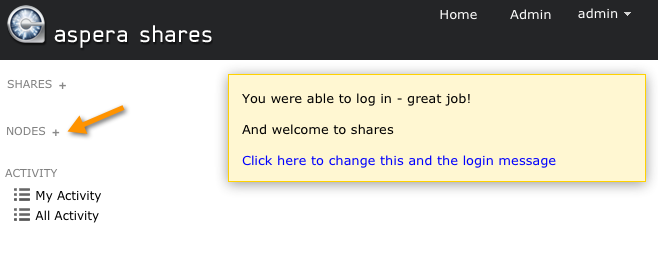
On the Home screen, click the NODE
+ button to add a new node and complete the
New Node configuration form.
You can quickly add a new node by clicking the NODE + on your Home screen.
When the New Node configuration screen appears, complete the form fields with the information you collected at the beginning of this exercise. Below is a description of each field, along with example values.
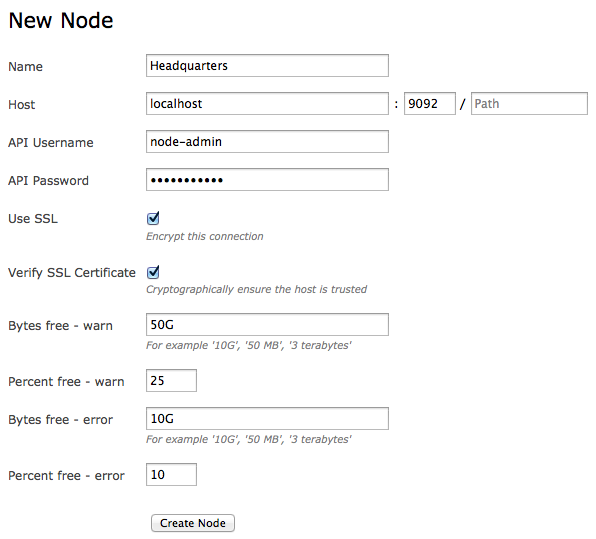
Field Description Sample Value Name A description of the node. "Headquarters" Host The node computer's hostname or IP address, along with a port and path (if applicable). The "port" field represents the port on which the node service is running; which, by default, is 9092. The "path" field is an advanced feature used for URL proxying. In nearly all cases, you may leave this field blank. In our example, the Shares application and Enterprise Server are installed on the same computer. That means our hostname is localhost and our node service port is HTTPS 9092. If the node is on a remote host, use the IP address or resolvable hostname, e.g. "10.1.2.3" and "9092". API Username The node API username that you created when you set up Enterprise Server on your node machine. Note that this user is kept in the redis database for authentication between the Shares application and the node service. "node-admin" API Password The node API password that you created when you set up Enterprise Server on your node machine. "s3cur3_p433" Use SSL To encrypt the connection to the node using SSL, enable this box. Although the node is configured to use Aspera's pre-installed, self-signed certificate (/opt/aspera/etc/aspera_server_cert.pem), you can use your own certificate by replacing the files located in the following directories: - /opt/aspera/shares/conf/cert.key
- /opt/aspera/shares/conf/cert.pem
To generate a new certificate, follow the instructions provided in the topic "Setting up SSL for your Node(s)" and use the OpenSSL command-line binary (/opt/aspera/shares/bin/openssl).
IMPORTANT NOTE: After generating a new certificate, you must create a “cert.pem” file that contains both the private key and the certificate. To do so, copy and paste the entire body of the key and cert files into a single text file (i.e. paste the private key, the certificate, and then save the file as "your_cert.pem").
Enabled, by default. Verify SSL Certificate To verify the SSL certificate, enable this box. Enabled, by default. Bytes free - warn If you would like to receive a warning message when the node has equal to or less than a certain number of storage bytes free, then enter that number into this field. You can input the number as G, MB, terrabytes and bytes. 50G Percent free - warn If you would like to receive a warning message when the node has equal to or less than a certain percent of its storage free, then enter that percentage into this field. 25% Bytes free - error If you would like to receive an error message when the node has equal to or less than a certain number of storage bytes free, then enter that number into this field. You can input the number as G, MB, terrabytes and bytes. 10G Percent free - error If you would like to receive an error message when the node has equal to or less than a certain percent of its storage free, then enter that percentage into this field. 10% -
Save and confirm.
After inputting the node details, click the Create Node button. If your node has been successfully created, it will appear under the Nodes section on your Home page.
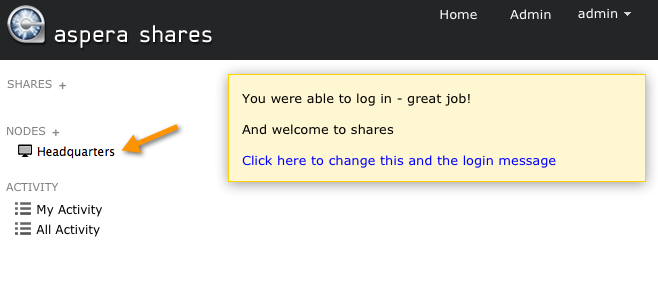
From here, you can perform multiple actions.
- Click the node's name to browse files on the node
- Use the drop-down menu to the right of the node name to browse, edit, view shares, view admin activity or delete the node.
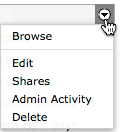
For detailed information on these functions, please refer to the topic "Node Functions".
IMPORTANT NOTE: One machine can be added as a node multiple times, in the circumstance that different access credentials are required to see files in multiple areas of the system.