Troubleshoot the problem that your clients cannot connect to your IBM Aspera Point-to-Point Client.
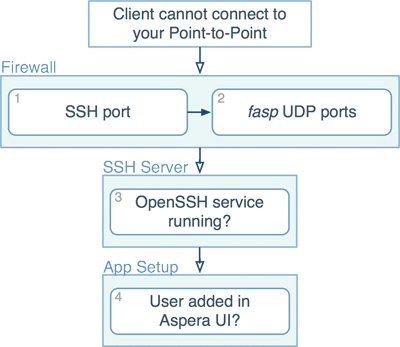
The following diagram shows the troubleshooting procedure if clients
can't establish a FASP transfer connection to your Point-to-Point. Follow the
instructions to identify and resolve problems:
-
Test SSH ports
To verify the SSH connection port, on the client machine, open a Terminal or a Command Prompt, and use the telnet command to test it. For example, to test connection to a computer (10.0.1.1) through a port (TCP/33001), use this command:
> telnet 10.0.1.1 33001
If the client cannot establish connections to your Point-to-Point, verify the port number and the firewall configuration on your Point-to-Point machine.
-
Test UDP ports
If you can establish an SSH connection but not a FASP file transfer, there might be a
firewall blockage of FASP's UDP port. Please verify your UDP connection.
-
Verify SSH service status
If there is no firewall blockage between the client and your Point-to-Point, on the client machine, try establishing a SSH connection in a Terminal or a Command Prompt: (Point-to-Point address: 10.0.1.1, login: asp1, TCP/33001)
$ ssh asp1@10.0.1.1 -p 33001
If the SSH service runs normally, the client should see a message prompting to continue the connection or for a password. However, if you see a "Connection Refused" message, which indicates that the SSH service isn't running, review your SSH service status. Ignore the "permission denied" message after entering the password, which is discussed in next steps.
-
Verify that the user account is added in Point-to-Point
If the client can establish SSH connections, but your Point-to-Point keeps
prompting for login credentials, the user account may not be properly
configured for FASP connections. Make sure that the login information is
correct, and refer to Setting Up Users to review the
user account's configuration.
If you still encounter connection problems after going through these steps, contact Technical Support.