After adding your directory service to Shares, you can configure specific settings for your DS user(s) and group(s).
| Tab | Description |
|---|---|
| Detail | Update the information that you inputted for the DS account when you first set it up. 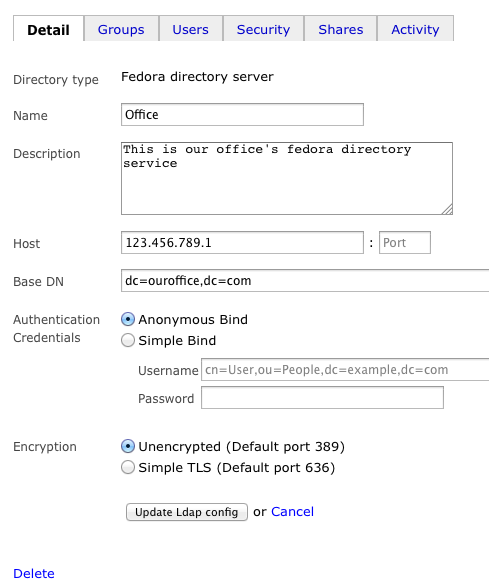 |
| Groups | View and edit your DS group permissions. Your DS groups will be listed on this page, along with Edit buttons. 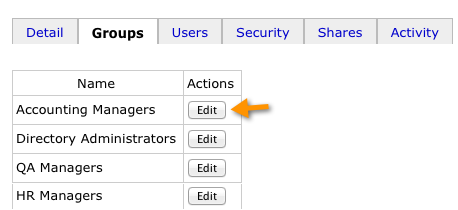 To set specific permissions for an individual DS group, click the corresponding Edit button. For further instruction on editing a DS group, please refer to the section "Setting Permissions for Individual DS Groups." |
| Users | View and edit your DS users' permissions. Your DS users will be listed on this page (unless the number of records exceeds Shares' limit for displaying a list), along with Edit buttons. If no list appears, you can search for users by name (where you must input a minimum of one character to perform a search). 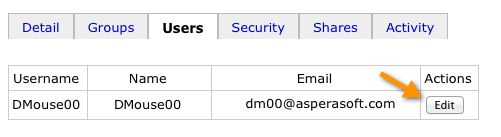 To set specific permissions for an individual DS user, click the corresponding Edit button. For further instruction on editing a DS user, please refer to the section "Setting Permissions for Individual DS Users." |
| Security | This tab allows you to configure specific security settings for the entire directory.
To configure DS users' security settings from their individual account pages, please refer to the section "Setting Permissions for Individual DS Users." 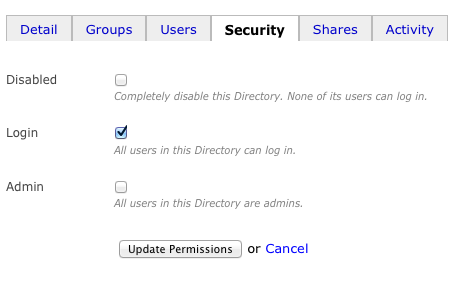 |
| Shares | Click the Add Share link to authorize specific shares for this directory. 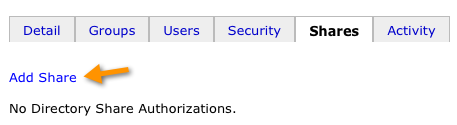 Upon doing so, you will be provided a list of nodes and shares that are currently configured in your Shares application, along with an Authorize link. 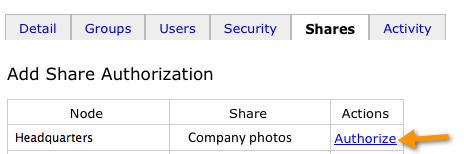 After authorizing a share, you can modify the directory's permissions for browsing, transferring and performing file operations within it. Note that the default permission is browse only. To edit these permissions or de-authorize the directory's access to the share, click the edit link. 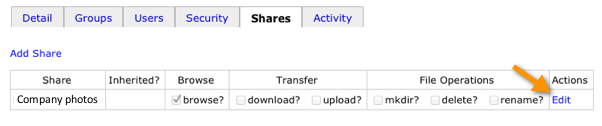 From here, select (checkmark) permissions that directory users have for the authorized share. For example, everyone in this directory is allowed to browse the company's event photos; however, they cannot download, upload, or perform any file operations within the share. After modifying your settings, click the Update button. You may de-authorize access to this share by clicking Delete. 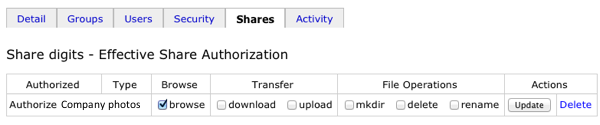
IMPORTANT NOTE: If you authorize a share for an entire directory, then any group within that directory will inherit the same access permissions. |
| Activity | View and search for activity within this directory. 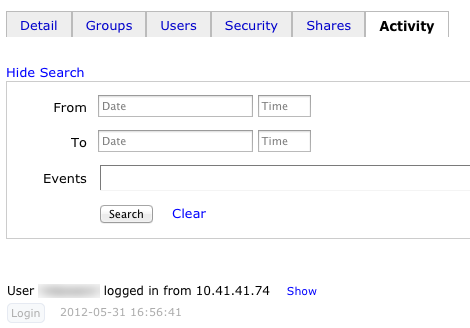 |
Setting Permissions for Individual DS Groups
You may configure your DS groups with unique settings (rather than defaulting to the directory settings). You will arrive at the tabs below after clicking the Edit button for a corresponding DS group.
| Tab | Description |
|---|---|
| Detail | View the DS group's name, modify the directory, or delete the directory from the Shares application. 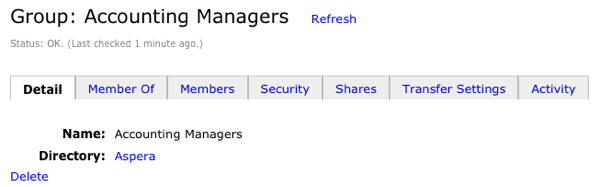 |
| Member Of | If this group is a member of another group, then that will be indicated under this tab. 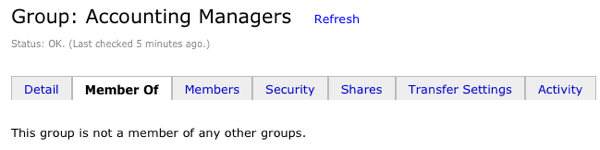 |
| Members | Displays this group's DS members and allows you to edit corresponding DS user settings. Please refer to the section "Setting Permissions for Individual DS Users" for details on editing DS user settings. 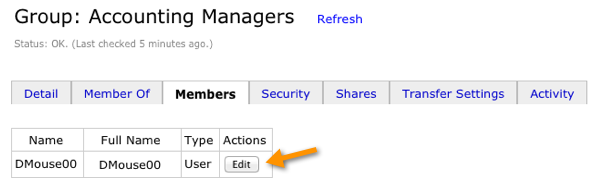
|
| Security | This tab allows you to configure specific security settings for all members of the DS group, including whether or not all members of the group can log into Shares, as well as if all members of the group are administrators. If you select (checkmark) Login, then all users in this group can log into Shares. If you select (checkmark) Admin, then all users in this group have Administrative permissions. If you leave these boxes unselected, then you can configure each local users' security settings from their individual account pages. Please refer to the topic Configuring Local Users for details. 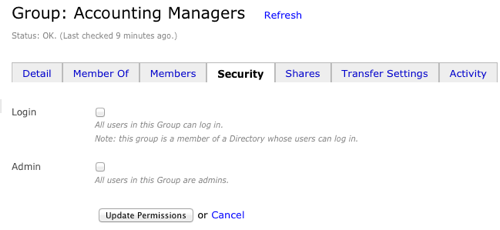 |
| Shares | Click the Add Share link to authorize specific shares for the members of this DS group to access. 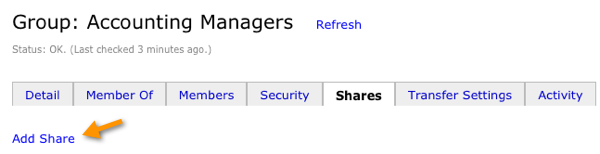 Upon doing so, you will be provided a list of nodes and shares that are currently configured in your Shares application, along with an Authorize link. 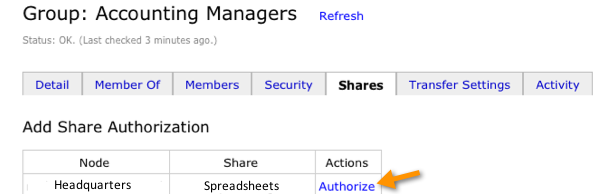
IMPORTANT NOTE: If you authorized a share for this DS group's entire directory, then this group will inherit the same access permissions for that share. After authorizing a share, you can modify the DS group's permissions for browsing, transferring and performing file operations within it. Note that the default permission is browse only. To edit these permissions or de-authorize the DS group's access to the share, click the edit link. 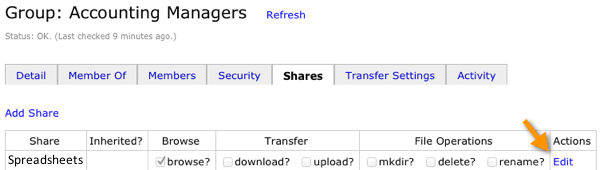
IMPORTANT NOTE: If the share had been authorized for this DS group's entire directory, then the Inherited? column will be populated with the text "Inherited." From here, select (checkmark) permissions that group members have for the authorized share. For example, our accounting department is allowed to browse, download and upload spreadsheets, as well as perform all file operations within the "Spreadsheets" share. 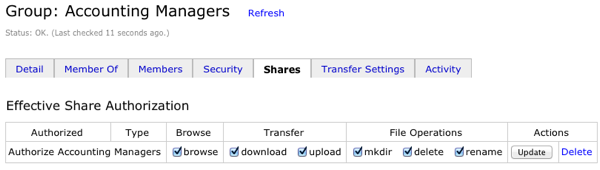 After modifying your settings, click the Update button. You may de-authorize access to this share by clicking Delete. |
| Transfer Settings | Implement transfer settings/restrictions specifically for members of this group. In doing so, you will be overriding Share's app-wide transfer settings just for this group. To configure transfer settings just for this group, start by clicking the Override these settings button (which will enable the input boxes). 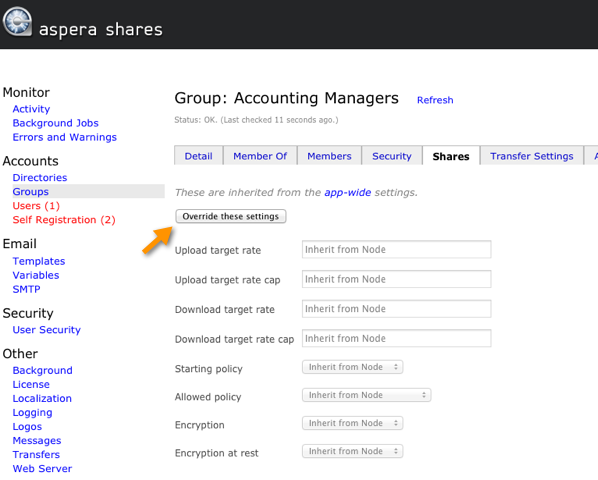 Now, you can configure your own transfer settings for this group. 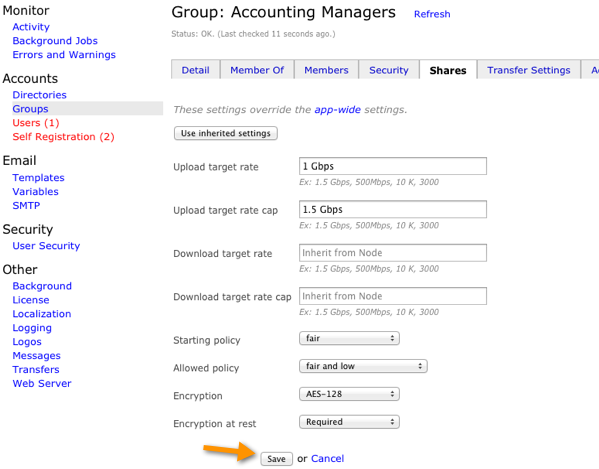 Transfer settings include the following:
Click the Save button to keep your new settings. You may also click the Use Inherited Settings button to return to the app-wide transfer configuration. |
| Activity | View and search for activity by members of this DS group. 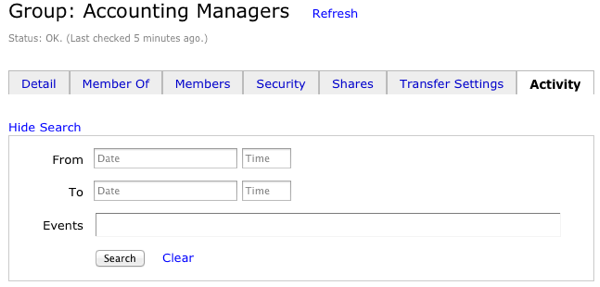 |
Setting Permissions for Individual DS Users
You may configure your DS users with unique settings (rather than defaulting to the directory or group settings). You will arrive at the tabs below after clicking the Edit button for a corresponding DS user.
| Tab | Description |
|---|---|
| Detail | View the DS user's name, modify the directory, or delete the user from the Shares application. 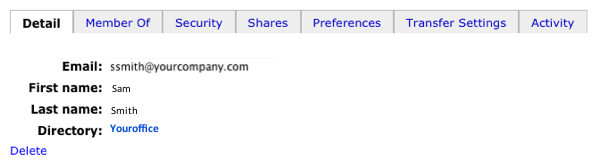 |
| Member of | Add this user to a DS group by selecting one from the drop-down list. You will only see DS groups that have been added to Shares (i.e. Setting Permissions for Individual DS Groups through the Shares UI). 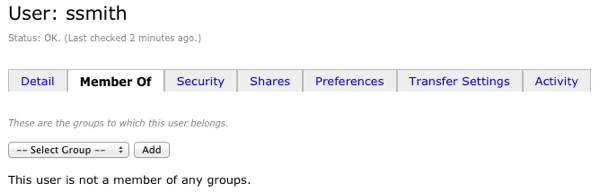
IMPORTANT NOTE: You will not be able to add DS users to a local group;
only DS groups. For instructions on configuring local users, see the topic Configuring Local
Users.
After adding a DS user to a DS group, you may click the Edit link to modify the group's settings or Remove to delete them from the group (but not from the Shares application). 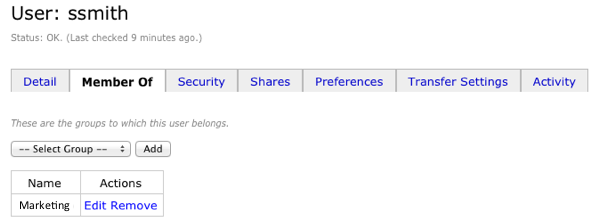 When you click the Edit link, you will be taken to DS group's configuration page. Please refer to the topic Setting Permissions for Individual DS Groups for details on modifying a DS group's settings. |
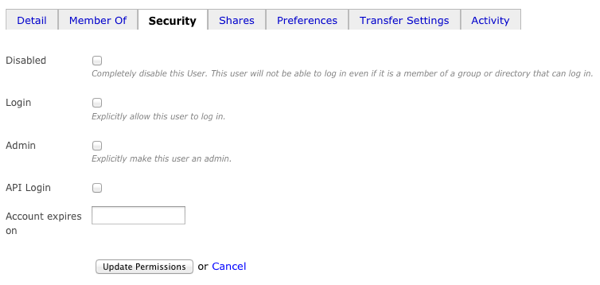
| Security | Under the Security tab, you can update the following
settings:
 |
| Shares | Click the Add Share link to authorize specific shares for the DS user to access. Note that if this user belongs to a DS group, and the group has access to a share, then that share will be listed here (i.e., permission to access the share is "inherited" from the group). The same is true if the entire directory has access to this share. 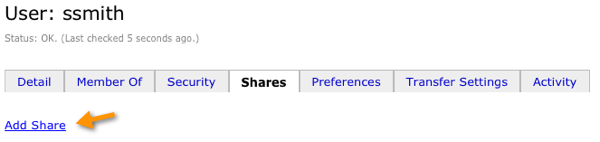 Upon doing so, you will be provided a list of nodes and shares that are currently configured in your Shares application, along with an Authorize link. 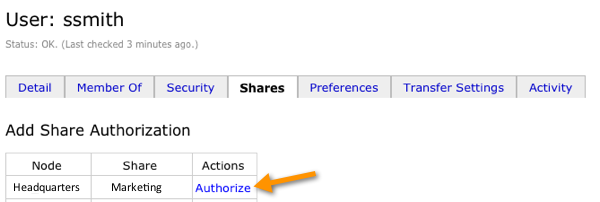 After authorizing a share, you can modify the DS user's permissions for browsing, transferring and performing file operations within it. Note that the default permission is browse only. If browse is not selected, the DS user will only be able to access functions if he or she has been made an API User (see Security tab description above). To edit these permissions or de-authorize the DS user's access to the share, click the edit link. 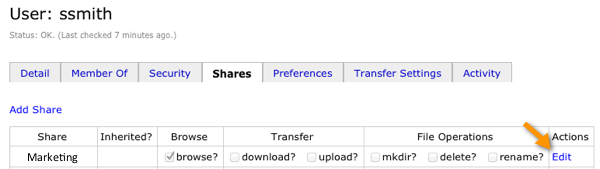 From here, select (checkmark) permissions that the DS user has for the authorized share. For example, the user in our office example is only allowed to download and browse the marketing share; however, he cannot upload content or perform any file operations within the share. 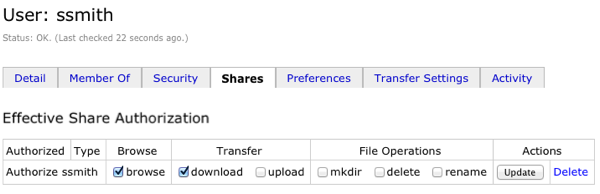 After modifying your settings, click the Update button. You may de-authorize access to this share by clicking Delete. |
| Preferences | Select a timezone and input any comments. 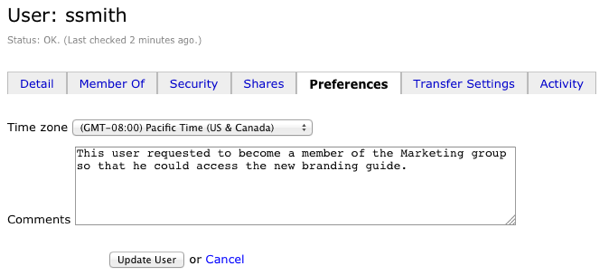 |
| Transfer Settings | Implement transfer settings/restrictions specifically for this DS user. In doing so, you will be overriding Share's app-wide transfer settings and DS group and/or directory settings. 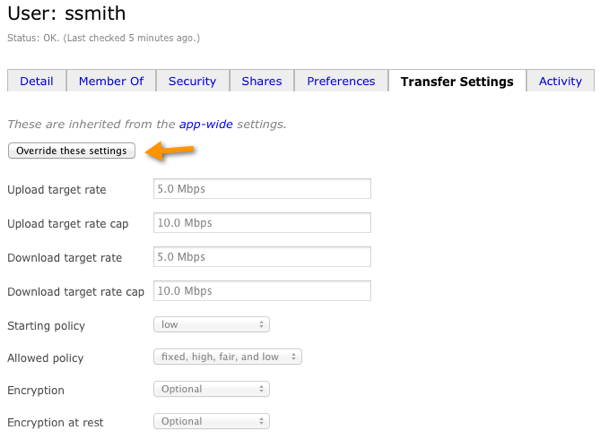 Transfer settings include the following:
|
| Activity | View and search for Shares activity by this user. 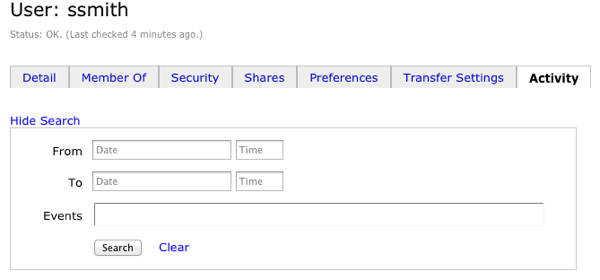 |